Silsila (1981)

★ 6.2 3h 2m 19 votes IMDb
Sign in to rate this film

When his brother's tragic death leaves his pregnant fiancée devastated, playwright Amit selflessly marries her to protect her from societal contempt. However, when fate brings him face-to-face with his former flame, love proves to be stronger than marital vows.
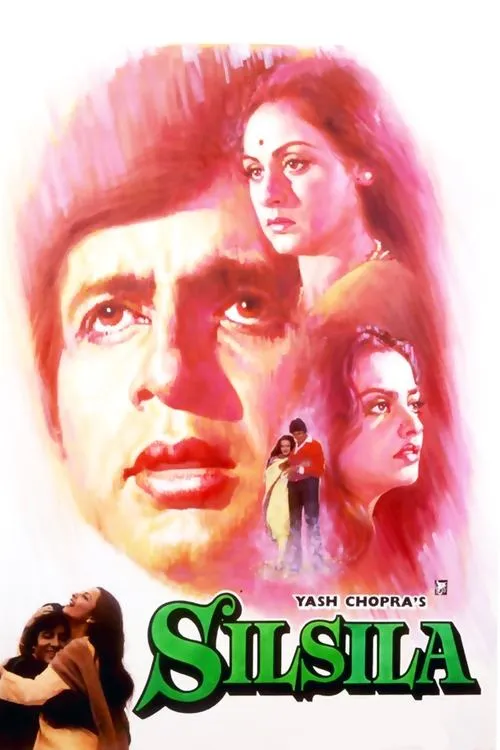
Silsila

Where to Watch

Netflix Netflix Watch
Amazon Prime Video Amazon Prime Video Watch
Disney Plus Disney Plus Watch
Max Max Watch
Hulu Hulu Watch
Paramount Plus Paramount Plus Watch
Apple TV Plus Apple TV Plus Watch
Peacock Peacock Watch
Starz Apple TV Channel Starz Apple TV Channel Watch
Eternal Family Eternal Family Watch
Here TV  Amazon Channel Here TV Amazon Channel Watch
DisneyNOW DisneyNOW Watch

Rent / Buy

Rent

Apple TV Apple TV Rent
Google Play Movies Google Play Movies Rent
Amazon Video Amazon Video Rent
YouTube YouTube Rent
Vudu Vudu Rent
Fandango at Home Fandango at Home Rent

Buy

Apple TV Apple TV Buy
Google Play Movies Google Play Movies Buy
Amazon Video Amazon Video Buy
YouTube YouTube Buy
Vudu Vudu Buy
Fandango at Home Fandango at Home Buy

Audience Reviews

THE-LENS Sep 19, 2026
# Film: *Silsila* (1981) – Yash Chopra’s Indecent Circus of Domestic Absurdity

**Film Title:** *Silsila* (1981)
**Director:** Yash Chopra (The Lazy Melodramatist)
**Core Performance Metrics:** Amitabh Bachchan (The Publicly Adulterous Playwright), Rekha (The Disjointed Mistress), Jaya Bachchan (The Grimacing Devotional Wife)
**Visual / Narrative Trait Markers:** The Vulgar Holi Adultery Song, The Teleported Airplane Rescue, The Homosexual Shower Soap Gag
**Thematic Axis:** The Mockery of Marital Sanctity / Illogical Script

**Starring:** Shashi Kapoor, Amitabh Bachchan, Jaya Bachchan, Rekha, Sanjeev Kumar

**Review by Dr Usman Latif Khawaja.**

Yash Chopra’s *Silsila* (1981) stands as an insanely illogical, indecent, and structurally broken piece of cinema—a very silly drama with a very stupid story and easily the worst script ever committed to a lavish production. Chopra completely squanders an elite, powerhouse cast to construct a narrative that openly makes a mockery of the institution of marriage under the guise of an elite, upper-class lifestyle.

While the first half operates with a slick, poetic elegance, the entire text systematically deconstructs itself after the halfway mark, defaulting to an avalanche of absolute madness and a catastrophic, lazily written resolution that matches the sheer narrative laziness Chopra later displayed in *Parampara* (1993).

It remains a permanent, historic warning in Bollywood history—a commercial failure so severe that Rekha never worked with Amitabh Bachchan again in a whole eternity, nor did Shashi Kapoor ever share a frame with the leading man after this flop.

## The Holi Defilement and the Adultery Circus

The structural decay of the script is exposed during the notorious Holi celebration sequence ("Rang Barse"). Up until this point, the film attempts to outline a sensitive, sane exploration of taboo sex and adulterous amour between Amit (Bachchan) and Chandni (Rekha), where their high-density close-ups look undeniably good on screen.

However, Chopra completely castrates this sensitive framing by turning an elite ceremony into a vulgar display of open adultery right in front of the local high-society cream:

**The Public Molestation:** Amit, an established playwright from an elite background, behaves like an absolute monster. Drenched in bhang, he openly mocks the marital institution by publicly fondling and dancing with the wife of his host in a sequence where, in any realistic, civilised society, he would have been instantly thrown out of the gates by security.

**The Asylum of the Triangle:** What follows this musical circus is pure psychological incoherence. Amit originally married Shobha (Jaya Bachchan) purely out of a bizarre duty after she was left pregnant with the illegal bastard child of his dead pilot brother, Shekhar (Shashi Kapoor).

Why he stubbornly refuses to simply divorce her after that child is clinically aborted remains a gaping plot hole left entirely unexplained. Instead, the script collapses into an asylum of mixed signals: a jaded-looking Jaya sings a devotional bhajan to Lord Rama to return her eloped husband, while simultaneously declaring she is pregnant—implying Amit was a hyperactive sexual predator maintaining parallel relations with both his wife and his mistress.

## The Teleported Savior and the Homosexual Shower Gag

The absolute peak of this narrative insult occurs during the film’s legendary, catastrophic climax, which completely shatters the laws of time, physics, and basic human reason:

**The Miraculous Teleportation:** While Amit and Chandni are actively eloping inside a luxury car, the cuckold husband, Dr. Anand (Sanjeev Kumar), is suddenly involved in a massive passenger airliner crash. The script literally teleports Amit from his highway escape vehicle straight into the burning inferno of the wreckage.

**The Selective Rescue:** Guided by what the movie implies is the divine intervention of Lord Rama, Amit steps past the screaming casualties—leaving the rest of the passengers to burn to death while the local fire brigade stands completely paralyzed—solely to pull out his singular sexual rival.

The characters then casually return to their homes to live happily ever after, leaving the viewer to wonder how many children Rekha is supposed to have raised with Sanjeev after this farce.

**The Barracks Innuendo:** This structural indecency is matched earlier by a bizarre, completely out-of-place shower sequence featuring a nude Shashi Kapoor and Amitabh Bachchan. Chopra inserts a crude, locker-room homosexual gag where the brothers challenge each other to pick up a piece of soap from the wet floor, explicitly implying that the man who bends down will get penetrated by the other, indicating they have casually experienced this exact routine in their shared past.

## The Verdict of the Gutter

While Shiv-Hari’s musical score provides two genuinely good classical tracks between Rekha and Amitabh, and the cinematography renders the frame look insanely lush and visually compelling, the film remains an aesthetic disaster.

It treats the human conscience not with the surgical precision of a master like King Vidor, but with a superficial, commercial vanity designed to titillate the masses while preaching a safe, hypocritical return to domestic normalcy in the final five minutes.

It is a film that attempts to make a total fool out of its audience—a masterpiece of pure caricature that belongs permanently in the critical gutter.

Similar Movies