No Bears (2022)

★ 6.9 1h 47m 133 votes IMDb
Sign in to rate this film

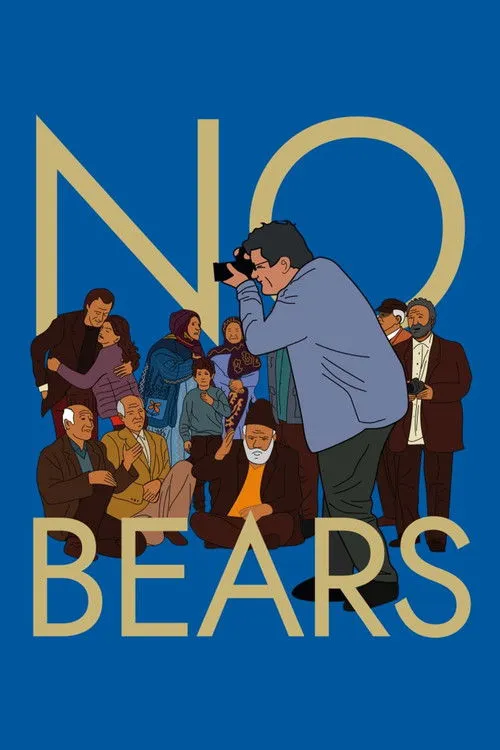
Iranian director Jafar Panahi, who has been barred from leaving the country, arrives at a village on the Iran-Turkey border to supervise a film based on a real-life couple seeking passports to Europe being shot in Turkey, but both his stay and the production run into trouble.
No Bears

Audience Reviews

CinemaSerf 6/10 Nov 17, 2022
Film director Jafar Panahi is prohibited from leaving Iran, but is trying to make a film in neighbouring Turkey. In order to make that work, he moves to a remote village near the border, where the communications are a bit hit and miss. With the help of his obliging host "Ghanbar" (Vahid Mobaseri), though, he tries to make the best of it. Initially, it's a friendly village but when he takes (or doesn't!) a photograph of a young couple, he finds himself drawn into an increasingly acrid stand-off between two young men, and their families, to whom a girl may have been betrothed when her umbilical cord was cut. His frustrations with these encroachments are not helped by production difficulties with the two two stars of his documentary-style film - real life lovers who are trying to find a way to escape, safely, to Paris. There is the slightest hint of menace here as the plot develops and although we see little actual evidence, there is a distinct sense that this man is increasingly unwelcome, despite the platitudes from the villagers, encouraging a sixth-sense feeling that the authorities are distantly watching this film-maker. There is a distinct perception of intimidation! What is also clear is that these ordinary Iranian people live in fear of the police, the Revolutionary guard and that rather flies in the face of their genuine, peaceable and hospitable, nature. Now, perhaps Panahi's less-is-more style works for some, but for me I found this all rather a slow watch. He shuffles around with little useful dialogue to develop his on-screen persona, nor my interest in him. Clearly this is a story about freedom and a sort of subliminal oppression but somehow the characters themselves here didn't really develop that theme sufficiently, nor did they really engage me. The ending, too, is disappointing and inconclusive in equal measure and I was rather underwhelmed. The film does offer us an interesting depiction of rural life that probably hasn't changed in millennia, but somehow I felt little better than a fly on the wall with nowhere near enough to go on to join in. Perhaps just too much of this is predicated on a knowledge by the audience of this director and of his relationship with his government.
badelf 9/10 Jul 17, 2026
Summary: 9/10: Panahi's defiant meta-documentary exposes the mechanics of authoritarian control through the lens of village superstition, proving that Iran's attempt to silence one of its greatest filmmakers has only made his voice more essential.


It's a small miracle that this film exists at all. In 2010, Jafar Panahi was sentenced to six years in prison; and a 20-year ban on filmmaking, writing screenplays, and international travel by Iranian authorities for what they called "making propaganda against the system." He made films anyway, smuggling them out of Iran on USB sticks, continuing to work in defiance of a regime determined to silence him. In 2022, shortly after completing this film, he was arrested again and detained for seven months before being released following a hunger strike.

No Bears proves Panahi hasn't lost his edge; if anything, his filmmaking has sharpened with constraint. Working in a documentary style, he plays a fictionalized version of himself directing a film remotely from a rural Iranian village near the Turkish border, unable to cross because of the government's travel ban. What unfolds is a piercingly self-aware exposition on invisible borders, superstition, and the stories that maintain authoritarian control, whether religious or governmental.

The villagers warn Panahi not to walk a certain path because of bears. There haven't been bears in the area for years, maybe decades, but the belief persists, passed down from generation to generation. Without education, without anyone willing to question inherited wisdom, the imaginary becomes as powerful as the real. The path remains forbidden not because of actual danger but because everyone agrees to believe in danger that no longer exists.

Panahi's political critique is devastating. The film explores what the "primitiveness" of village life, but it's not condescension; it's recognition that these dynamics are universal. My own grandmother had superstitions that made no logical sense but governed her behavior completely. And how many of us still say "gesundheit" or "God bless you!" when someone sneezes? The difference is scale and consequence. In the village, a photograph Panahi allegedly took becomes "evidence" in a morality case against a young woman, and suddenly unconfirmed belief, or the bear that may or may not be there, has the power to destroy lives.

Panahi structures the film around two parallel stories: the film-within-the-film about a couple trying to escape Iran, and his own entanglement in village politics when his camera becomes a tool of surveillance and accusation. The boundaries between the two narratives, between fiction and documentary blur deliberately; we're never quite certain what's staged and what's real, which is precisely the point. In a country where the state controls narrative, where a filmmaker can be imprisoned for telling stories the regime doesn't like, the act of making any film becomes inherently political.

The film reminded me of something Sam Harris once said: "I don't get that — people going to war over religion. I don't know, I could see going to war over justice or democracy or even revenge. But if you're going to war over religion, now you're just killing people in an argument over who has the better imaginary friend." The villagers' insistence on invisible bears, the morality police's enforcement of arbitrary rules, the government's persecution of artists: it's all the same mechanism. Belief systems that can't withstand scrutiny require force to maintain, whether that force comes from social pressure or state violence.

Panahi's brilliance lies in connecting dots between the microcosm of village superstition to the macrocosm of authoritarian control. Both depend on unquestioned belief, both punish deviation, both create borders that exist only in collective imagination but have entirely real consequences. The filmmaker can't cross into Turkey not because of any physical barrier but because his government says he can't. The woman faces punishment for living her own life outside the villagers' imaginary borders set up to maintain control over her.

No Bears won the Special Jury Prize at the Venice Film Festival; his award was accepted by two of the film's actors in his absence, the audience giving a standing ovation for a filmmaker imprisoned for refusing to stop making films.

Similar Movies