John Chard
9/10
Mar 04, 2014
Magnifique.
Le Samouraï, one of the most highly praised French films of the 1960s, and justifiably so. Having only just caught it for the first time, I'm not sure what more I can say about a film that has been discussed, dissected, praised and pored over for nearly five decades now.
Plot is simplicity, hit-man Jef Costello (Alain Delon) enacts a hit but he is witnessed fleeing the scene and spends the rest of the film trying to make sure his alibi holds up. His employers want him erased so as to avoid detection themselves, the head detective on the case knows Jef did it but can't quite close the noose around his neck, and Jef is mysteriously drawn to a sultry piano player who happens to be the chief witness against him!
Sparse of dialogue, this is a masterstroke decision by director Jean-Pierre Melville, because what chat there is makes us hang on every word being spoken. It also re-enforces the loneliness essence of the hit-man's life. Jef's apartment is so bland and devoid of personality, the only thing of beauty there is a bird in a cage, the metaphor of such is hard to ignore. Jef himself is beautiful, he also is perpetually in an emotionally frozen cage.
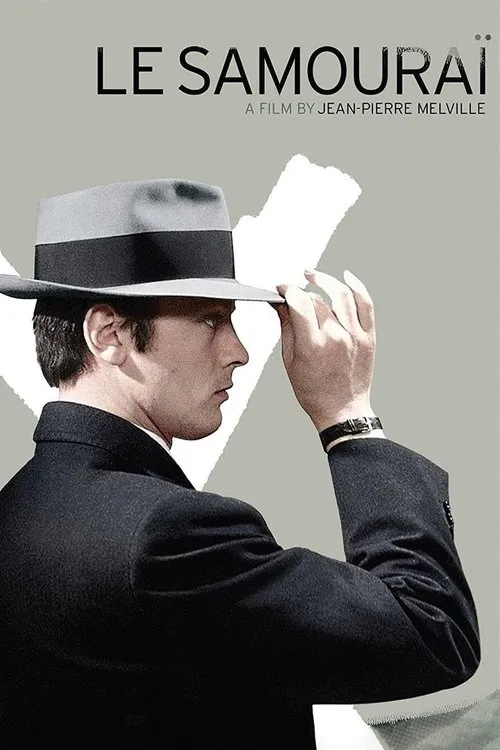
Attired in trenchcoat and fedora hat (or is it a trilby?), it's obvious that Delon and Melville are homaging with great respect the American film noir classic cycle. It's also quite amazing that although the film is technically filmed in colour, it still feels like one of those black and white noirs of the 40s and 50s. There's a coldness to Henri Decaë's (Ascenseur pour l'échafaud/Elevator to the Gallows) photography that so befits the story, the interiors are stripped of life, the exteriors almost always gloomy. And with the brilliant Delon as cool as an Eskimo's wedding tackle, icy veneers are all the rage here.
Hugely influential, Le Samouraï deserves every plaudit that has come its way. Best thing about it is that it actually gets better on a repeat viewing, because the surreal edge disappears the next time and in its place is an awareness of what the director is doing, and with that comes an appreciation of great film noir film making. Hell! Even the finale is pure noir of heart. 9/10
CRCulver
8/10
Sep 02, 2018
Jean-Pierre Melville's 1967 film <i>Le Samouraï</i> is the story of a hired assassin who slips up on a hit and his race against time to set things right. Jef Costello (Alain Delon) is given a contract to kill a nightclub owner, but on the way out he is seen by the club's pianist (Cathy Rosier) and then gets himself picked up in a police sweep. He finds himself pursued by both a cunning detective (François Périer) and by his disappointed employers. As the film progresses, Costello manages to elude both threats while remaining true to his bushido-like code of honour.
The strongest aspect of <i>Le Samouraï</i>, I feel, is Alain Delon's performance. Beginning with an utterly stoic mien and confidence, Costello gradually loses his cool over the course of the film, and Delon skillfully depicts this subtle collapse. Melville's direction is remarkable for its ability to sustain suspense (even across multiple viewings, when one already knows how it will go down), and it's curious how the audience is led to sympathy for this man who is basically a cold-blooded murderer. We are even denied a back story that might serve as an apology for his profession. Instead, Costello is just a robotic killing machine, but the film makes us feel concern for him nonetheless. There is also memorable soundtrack by François de Roubaix, an early example of electronic music.
Some aspects of the policework are presented in a clunky or unbelievable fashion (the detective has memorized every building in Paris, seriously?), so I cannot rate this as a flawless masterpiece. But still, it's a good film, and part of the basic education of a cinephile: <i>Le Samouraï</i> has proved vastly influential in the decades since its release, and those who have seen more recent films like Jim Jarmusch's <i>Ghost Dog</i> or Michael Mann's <i>Collateral</i> will recognize various aspects of those to be hommages to Melville's classic. <i>Le Samouraï</i>, in turn, looks back like many French films of this time to American film noir, as well as to the then-recent French New Wave.
markavrelii
Jan 13, 2022
Amazing movie! Withstood the test of times. Was watching it with a great interest unlike many movies of this era. Delon is magnifique! Unexpected plot and ending, but the title should have prepared me for it.
badelf
8/10
Oct 12, 2026
**Summary: 8/10:** A masterclass in dialogue economy and atmosphere that hasn't lost its craft, only its element of surprise, having spent sixty years teaching every assassin movie that followed how to be cool, quiet, and doomed.
A man lies motionless on a narrow bed in a room the color of a held breath; grey walls, grey light, a caged bullfinch for company. Three minutes pass before a word of dialogue arrives, and by then Jean-Pierre Melville has already told you everything you need to know about Jef Costello: his solitude, his discipline, his entombment in ritual. It remains one of the great opening sequences in cinema, and it announces the film's governing principle immediately. This is a movie built entirely on the conviction that action, gesture, and silence can carry more truth than dialogue ever could.
Melville invented a fake epigraph from the Bushido code to open the film, a kind of lie that tells a deeper truth; Jef Costello isn't a samurai, he's a Parisian hitman in a trench coat and fedora, but the warrior's code of discipline and fatalism fits him so precisely that the fabrication becomes its own form of honesty. Alain Delon, reportedly cast on the spot after Melville read him the nearly wordless script aloud, understood exactly what the role required: a face that gives away nothing, and therefore gives away everything. Melville himself said there was "something Japanese" about Delon's stillness, and watching the film now, it's hard to disagree; this is a performance built entirely out of posture, pacing, and the adjustment of a hat brim.
The technical case for this film is also nearly unimpeachable. Henri Decaë's cinematography, all desaturated blues and institutional greys, turns Paris into something closer to purgatory than a city; Melville reportedly wanted "a color film in black and white," and he nearly achieved it, going so far as to photocopy paper currency into monochrome facsimiles so no stray color would intrude on a frame. Roger Ebert called it right: Melville involves us in the spell of this film "before a word is spoken," with "light: a cold light, like dawn on an ugly day," and "actions that speak in place of words." That is the whole method in a sentence, and it's the reason the film still gets taught as a master class in the "show, don't tell" school of filmmaking.
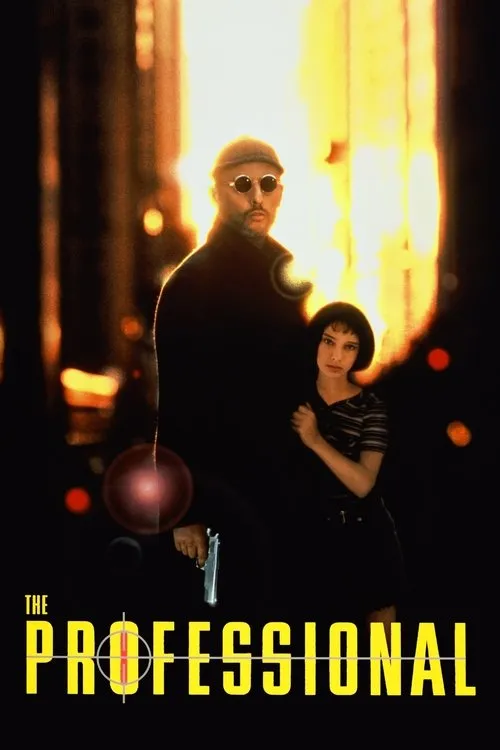
And yet, here is where I have to be honest rather than reverent. Watching *Le Samouraï* in 2026 means watching it after fifty-plus years of direct descendants: Walter Hill's *The Driver*, John Woo's *The Killer*, Besson's *Léon*, Fincher's *The Killer*, and most pointedly Jim Jarmusch's *Ghost Dog: The Way of the Samurai*. This last doesn't just borrow from Melville's film but builds its entire architecture around it. The problem with inventing the lodestone of a genre is that everyone who comes after you gets to use your invention without paying the toll of originality, and by now the solitary, code-bound, fastidiously dressed assassin has become such a stock figure that it's genuinely difficult to feel the jolt this film must have delivered in 1967. The patience, the silences, the methodical tradecraft; all of it has been absorbed into the bloodstream of the genre so thoroughly that it now reads as familiar rather than revelatory. That's not a failure of the film. It's a tax that innovation pays when its innovations are so successful; the influence becomes invisible because it became standard.
So I find myself in the slightly strange position of recognizing a film's mastery while not quite feeling its charge. The craft is immaculate. Delon's performance, Decaë's lensing, Melville's unerring control of tempo and silence; none of it has aged a day. But the experience of watching it has been diluted by everything it made possible, and that dilution is worth naming honestly rather than pretending I felt a revelation that sixty years of imitation have made impossible to feel fresh.
What I keep returning to is that bullfinch in the cage, and the ritual of the gloves and the hat, and the sense that Jef Costello has reduced his entire existence to a code so rigid it functions as armor against feeling anything at all. That's a more interesting character study than most contemporary assassin movies bother attempting, even the ones that learned every visual trick from this one. Melville was not just building atmosphere for its own sake; he was building a portrait of a man who has mistaken discipline for meaning, and who discovers, too late, that a code without warmth is just another kind of cage.


 Fandango at Home
Rent
Fandango at Home
Rent