Ghulami (1985)

★ 7.3 2h 51m IMDb
Sign in to rate this film

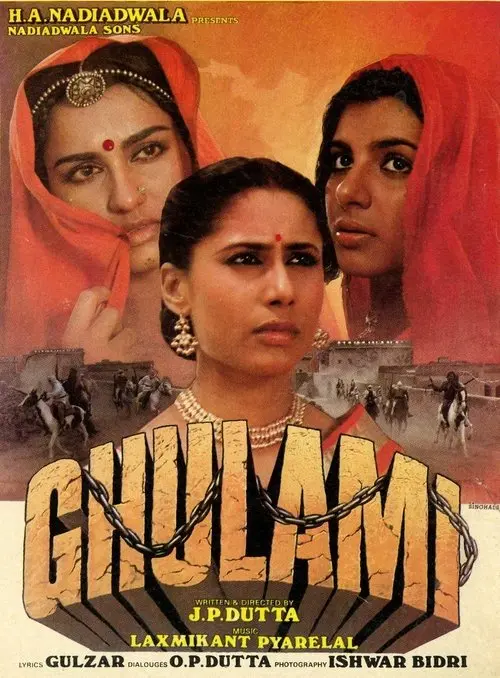
In feudal Rajasthan, a bunch of peasants rise up against the exploitative landowners and the age-old system of caste-based oppression.
Ghulami

Where to Watch

Netflix Netflix Watch
Amazon Prime Video Amazon Prime Video Watch
Disney Plus Disney Plus Watch
Max Max Watch
Hulu Hulu Watch
Paramount Plus Paramount Plus Watch
Apple TV Plus Apple TV Plus Watch
Peacock Peacock Watch
Starz Apple TV Channel Starz Apple TV Channel Watch
Eternal Family Eternal Family Watch
Here TV  Amazon Channel Here TV Amazon Channel Watch
DisneyNOW DisneyNOW Watch

Rent / Buy

Rent

Apple TV Apple TV Rent
Google Play Movies Google Play Movies Rent
Amazon Video Amazon Video Rent
YouTube YouTube Rent
Vudu Vudu Rent
Fandango at Home Fandango at Home Rent

Buy

Apple TV Apple TV Buy
Google Play Movies Google Play Movies Buy
Amazon Video Amazon Video Buy
YouTube YouTube Buy
Vudu Vudu Buy
Fandango at Home Fandango at Home Buy

Audience Reviews

THE-LENS Sep 20, 2026
**Film: Ghulami**

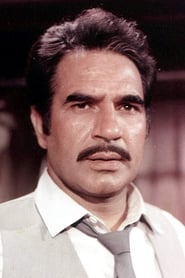
Directed by [J. P. Dutta](https://en.wikipedia.org/wiki/J._P._Dutta) (in his directorial debut). The film features an ensemble cast of [Dharmendra](https://en.wikipedia.org/wiki/Dharmendra), [Mithun Chakraborty](https://en.wikipedia.org/wiki/Mithun_Chakraborty), [Naseeruddin Shah](https://en.wikipedia.org/wiki/Naseeruddin_Shah), [Kulbhushan Kharbanda](https://en.wikipedia.org/wiki/Kulbhushan_Kharbanda), [Smita Patil](https://en.wikipedia.org/wiki/Smita_Patil), [Reena Roy](https://en.wikipedia.org/wiki/Reena_Roy), [Anita Raj](https://en.wikipedia.org/wiki/Anita_Raj), [Raza Murad](https://en.wikipedia.org/wiki/Raza_Murad) and [Om Shivpuri](https://en.wikipedia.org/wiki/Om_Shivpuri).

**Review by Dr Usman Latif Khawaja MB, MRCP UK; Ireland; STA London Royal College of Physicians**

**Rating ⭐⭐⭐⭐⭐ 5 out of 5 stars**

# **A BALLAD FOR THE BOLD AND THE**

J. P. Dutta's first cinematic venture in 1985 deals with the 'Jatt Revolution' in the heartlands of India, as the peasants rise against the tyrannical landlords to recover their stolen lands and dignity, which has been mauled for centuries. The movie deals with the intricacies of the corruption that absolute power can breed into the human soul, and yet optimizes the struggle as a victory for human valour, giving hope to a much-maligned human race.

From the initial sequences, where a 'tenant' \[Dharmendra\] swears to avenge his father's death and restore his family honour, to the tragic finale, this movie is a tribute to the human spirit and its aspirations to liberate itself from the shackles of oppression and tyranny.

The soul of the movie is captured by the taciturn soldier played by Mithun Chakraborty, who returns home to find an enemy deadlier than the one he was waging a war on at the borders of his land. As the headstrong, stubborn, yet quietly dynamic young man, he brings a throbbing romanticism to his role of a man passionately in love with a vulnerable, lonely young beauty played with a rare dignity by Anita Raj. The enigmatic, doomed love affair is narrated poetically from the sun-drenched fields of corn to the ornate palaces of the corrupt aristocrats, where the two are immortalised by their pristine love.

Mithun's performance is a raw, spontaneous textbook act for an intensely idealistic revolutionary who establishes himself as a champion for the desecrated weaker sex and for the famished peasants trying to get rid of their yokes. This is an awe-inspiring and realistic portrayal which steals the glory from an excellent cast, where Naseeruddin Shah plays the establishment as a cop who is hunting the rebels, but then starts viewing their cause sympathetically after the truth is revealed.

The script progresses with its lyrical prose and the great poems and musical soundtrack penned by Gulzar, with the immensely enchanting love poem—"Zee Hale Masti"—which is choreographed uniquely in picturesque rural India with astonishing sunsets and rooftop bus journeys, as undertaken by the masses in reality. Yet it still finds enough to celebrate the spirit of the ordinary people through buoyant verses and the totally natural yet graceful dancing of Mithun with the gypsy girls roaming the heartlands as homeless vagrants.

The movie falters with its clumsy action, as the technical aspects are not top-notch, and Dharmendra gives a stereotyped portrayal of a revolutionary seeking personal vendetta. But there is enough here to forego those flaws, and the movie has a poetic and savage passion, with Mithun's matchless intensity to stir even the most lifeless souls.

Dutta's fervent concept of revolution is his best and first effort to date and throbs with a rare vitality unseen in Indian cinema of the eighties. As it details the social injustices prevalent in the modern age in a primitive society—from the ragged peasants to the luxurious palaces of the rich—this brings a poignant view to class discrimination. The eloquence with which the tale is narrated will leave you pondering if indeed India is still colonised or free, with only a change of the ruling establishment.

A tragic, heart-rending, romantic ballad for the brave who dare to walk into the trap of their own doom for the love of their ideals.

Similar Movies