22 July (2018)

★ 7.1 2h 23m 1,291 votes IMDb
Sign in to rate this film

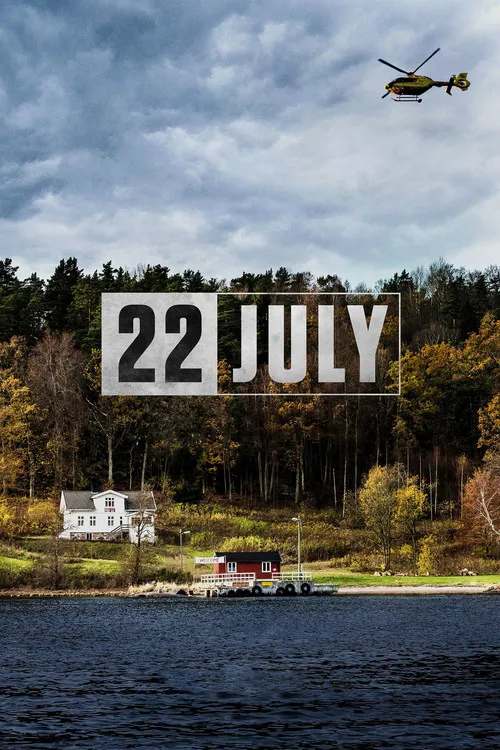
On 22 July 2011, neo-Nazi terrorist Anders Behring Breivik murdered 77 young people attending a Labour Party Youth Camp on Utøya Island outside of Oslo. This three-part story focuses on the survivors, the political leadership of Norway, and the lawyers involved.
22 July

Where to Watch

Netflix Netflix Watch
Amazon Prime Video Amazon Prime Video Watch
Disney Plus Disney Plus Watch
Max Max Watch
Hulu Hulu Watch
Paramount Plus Paramount Plus Watch
Apple TV Plus Apple TV Plus Watch
Peacock Peacock Watch
NBC NBC Watch
Shahid VIP Shahid VIP Watch
Toku Amazon Channel Toku Amazon Channel Watch
AMC+ Roku Premium Channel AMC+ Roku Premium Channel Watch

Rent / Buy

Rent

Apple TV Apple TV Rent
Google Play Movies Google Play Movies Rent
Amazon Video Amazon Video Rent
YouTube YouTube Rent
Vudu Vudu Rent
Fandango at Home Fandango at Home Rent

Buy

Apple TV Apple TV Buy
Google Play Movies Google Play Movies Buy
Amazon Video Amazon Video Buy
YouTube YouTube Buy
Vudu Vudu Buy
Fandango at Home Fandango at Home Buy

Audience Reviews

StamS 7/10 Apr 25, 2025
A dry film that fails to highlight the true face of the emerging phenomenon of Nazism in Europe. Greengrass (director and screenwriter) tries (and succeeds in some scenes) to shock, but this is not enough for the viewer to understand how dangerously neo-Nazi ideology has infected the Western world. The creators seem to believe that simply narrating such a senseless act is enough to awaken viewers, but they are wrong.

To truly understand both the sick essence and the causes that are bringing this monstrous ideology back to the forefront, we need to look in the mirror. We need to understand and, consequently, accept that the root of Nazism lies in the heart of the societies we have built around us.

Nazism did not fall from the sky. Breivik did not fall from the sky, nor was he born from a metaphysical Hell. He was born, raised, and lives among us. He is our neighbour. He is the one who usually says "we need a Franco," "under the military Junta everyone had a job," "I have no problem with illegal immigrants, but...".

That is why, in my opinion, the only intensely bright spot of the film is Breivik's last line to his lawyer at the end of the film. A line that concludes a conversation between the two of them, in which the lawyer seemingly wins on points, as he chooses not to respond to this line.

"You don't even see us."

This line encapsulates the whole problem of European Nazism, as the vast majority of our fellow citizens choose to turn a blind eye to all of this. We choose to look the other way, to pretend we didn't see how the supermarket clerk spoke to the immigrant customer, not to react to the bus driver when he unreasonably forces the refugee child off the vehicle, to continue getting our information from journalists who whitewash fascists at every opportunity, offering them a platform to utter lies sprinkled with half-truths.

Europe has turned a blind eye. It has chosen not to see Nazism in France, Italy, Sweden, the UK, Germany, Greece, Ukraine, Hungary, and other countries because it considers other problems more important. And to a certain extent, it is right. Nazism is not the most important problem. But it is the most deafening alarm that everything is wrong: the bail out of banks, the violation of human rights, the abolition of labour rights, austerity policies, in short, the abandonment of citizens to the mercy of capital and economic growth.

And all this with the complicity of our own awkwardness and inaction.

So, we don't even see them, because we have more important problems to deal with and because in our dizziness and panic as we drown, we will grab anything that even faintly appears as something that can keep us afloat. Many will grasp the weight of Nazism and drag down with them those around them, just as happened 90 years ago.

Similar Movies