November (2017)

★ 7.1 1h 55m 174 votes IMDb

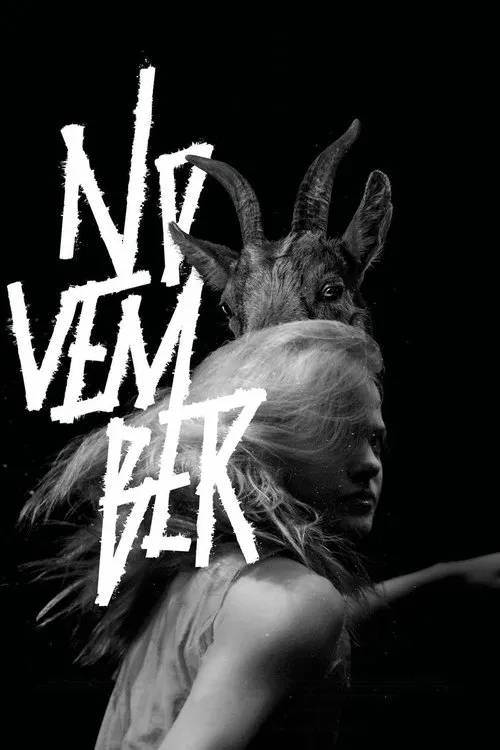
In a poor Estonian village, a group of peasants use magic and folk remedies to survive the winter, and a young woman tries to get a young man to love her.
November

Where to Watch

Netflix Netflix
Amazon Prime Video Amazon Prime Video
Disney Plus Disney Plus
Max Max
HBO Max HBO Max
Hulu Hulu
Paramount Plus Paramount Plus
Apple TV Plus Apple TV Plus
Peacock Peacock
Showtime Showtime
Starz Starz
Paramount+ with Showtime Paramount+ with Showtime

Rent / Buy

Rent

Google Play Movies Google Play Movies Rent
YouTube YouTube Rent
Vudu Vudu Rent
Apple TV Apple TV
Amazon Video Amazon Video
Fandango at Home Fandango at Home

Buy

Google Play Movies Google Play Movies Buy
YouTube YouTube Buy
Vudu Vudu Buy
Apple TV Apple TV
Amazon Video Amazon Video
Fandango at Home Fandango at Home

Cast

Rea Lest-Liik
Rea Lest-Liik as Liina Age 35 · Tallinn, Harju County, Estonian SSR, USSR [now Estonia] Rea Lest-Liik (born May 14, 1990) is an Estonian stage and film actress who came to prominence in the 2010s following leading roles in several Estonian films, such as November and Manslayer/Virgin/Sha...

Jörgen Liik
Jörgen Liik as Hans / Snowman (voice) Died 2025 · Kuressaare, Saare County, Estonian SSR, USSR [now Estonia] Jörgen Liik (March 12, 1990 – July 13, 2025) was an Estonian stage, film and television actor. Jörgen Liik was born in Kuressaare, Saare County on the island of Saaremaa. He attended primary school a...
Arvo Kukumägi
Arvo Kukumägi as Rein Died 2017 · Litvina, Põlva County, Estonian SSR, USSR [now Estonia] Arvo Kukumägi (August 9, 1958 – May 16, 2017) was an Estonian film and theatre actor. In 1980 he graduated from Tallinn State Conservatory's Performing Arts Department. 1980-1984 he was an actor at E...
Heino Kalm
Heino Kalm as Sander Age 70
Meelis Rämmeld
Meelis Rämmeld as Jaan Age 51 · Tallinn, Harju District, Estonian SSR, USSR [now Harju County, Estonia] Meelis Rämmeld (born April 4, 1975 in Tallinn) is an Estonian actor. In 1997 he graduated from Viljandi Culture Academy Theatre Department. After graduating he worked in Ugala Theatre.

Katariina Unt
Katariina Unt as Luise Age 54 · Tallinn, Estonian SSR, USSR [now Harju County, Estonia] Katariina Unt (born Katariina Lauk; December 6, 1971) is an Estonian stage, television, and film actress. Katariina Unt was born in Tallinn. Her mother is interior decorator Malle Lauk and her father...

Audience Reviews

tmdb28039023 6/10 Sep 13, 2022
In the real world, magical thinking is a type of fallacy and a source of many superstitions, but in a film like November, it can be the difference between life and death, salvation and damnation. The characters in this Bergmanesque Estonian-German fairy tale, written and directed by Rainer Sarnet, live in a village surrounded by an honest-to-goodness Haunted Forest, although for them it would be weird if it weren’t haunted — to put it in perspective, pacts with the devil are so common that cunning villagers manage to fool the devil by using the sap of blackcurrants instead of blood to sign the contract.

I find it curious that both All Movie and Wikipedia state that the movie is set in the 19th century, because it feels more like the Late Middle Ages, complete with the Plague. On the other hand, this is a world where almost anything is possible — cheating death as well as the devil; one of these clever villagers has a brilliant idea: “Take off your pants and put them on your head. The plague will think we have two butts and won't dare to touch us." We are tempted to poke fun at these ignorant peasants, but then the Plague, in the form of a white goat, does indeed pass them by harmlessly — at least for the time being.

The characters employ various other, for lack of a better term, 'lifehacks,' to survive the harsh winter; the most popular of these is the kratt, which in turn explains the frequency of pacts with the devil — the kratt, a magical creature in ancient Estonian mythology, is formed from hay or old household utensils, but needs to be imbued with a soul to carry out the orders of its master; the villagers summon the devil at a crossroads to make a deal: to buy a soul for their kratt in exchange for their own souls down the line.

The problem is that kratts are excessively 'gung ho', and capable of making an attempt on the lives of their owners if they do not provide them with something to do all the time; consequently, the kratt's master would ask the creature to do impossible things, such as build a ladder out of bread. The main task of the kratt in November is to hook the viewer, and in my case it more than succeeded thanks to the film’s practical special effects.

Hans (Jörgen Liik), who is either a genius or too dumb to live, fashions a snow kratt; there is no danger that it will attack him, but there is also no hope that it will do much for him. Hans wishes the kratt would bring him a young baroness, the daughter of the local German baron, with whom he is infatuated; sadly, the Baroness isn't a cow (kratts can't steal humans, only cattle and inanimate things), and even if she was, this kratt is particularly fragile.

The only benefit Hans can gain from the situation is that of his kratt's vast experience ("Where did you learn to talk like that, kratt?"; "Everywhere. I ran through ancient cities like a river, bubbling in splendid Gardens like a fountain, I fell like rain and carried countless ships. Now I am snow, and for the first time I have the ability to speak through the mouth you gave me, Master").

Given this general state of affairs, it’s not surprising that a villager is caught scraping gold from a Christian altar; “Why did you scrape it?”; “You know that the altar is sacred. If I pay with it at the bar, the gold will go back to my pocket.” However, in an ironic twist, the peasant woman is ridiculed: “how will it come back? Walking?"

The notion that "Jesus will bring it" back because "it's holy gold" is an example of magical thinking just as blatant as putting your pants on your head to outwit the Plague; why, then, is one taken seriously and the other a cause for ridicule?

One reason is that the idea is from a Latvian and “Latvians have an ass for a mouth and only shit comes out”, but there is something more complex at play; Sarnet not only juxtaposes the Apollonian and Dionysian natures of Christianity and paganism, but also reverses the physical and metaphysical roles of each religion.

Similar Movies